
By the Pakuran Editorial Team · Last updated: October 22, 2026 · 12 min read
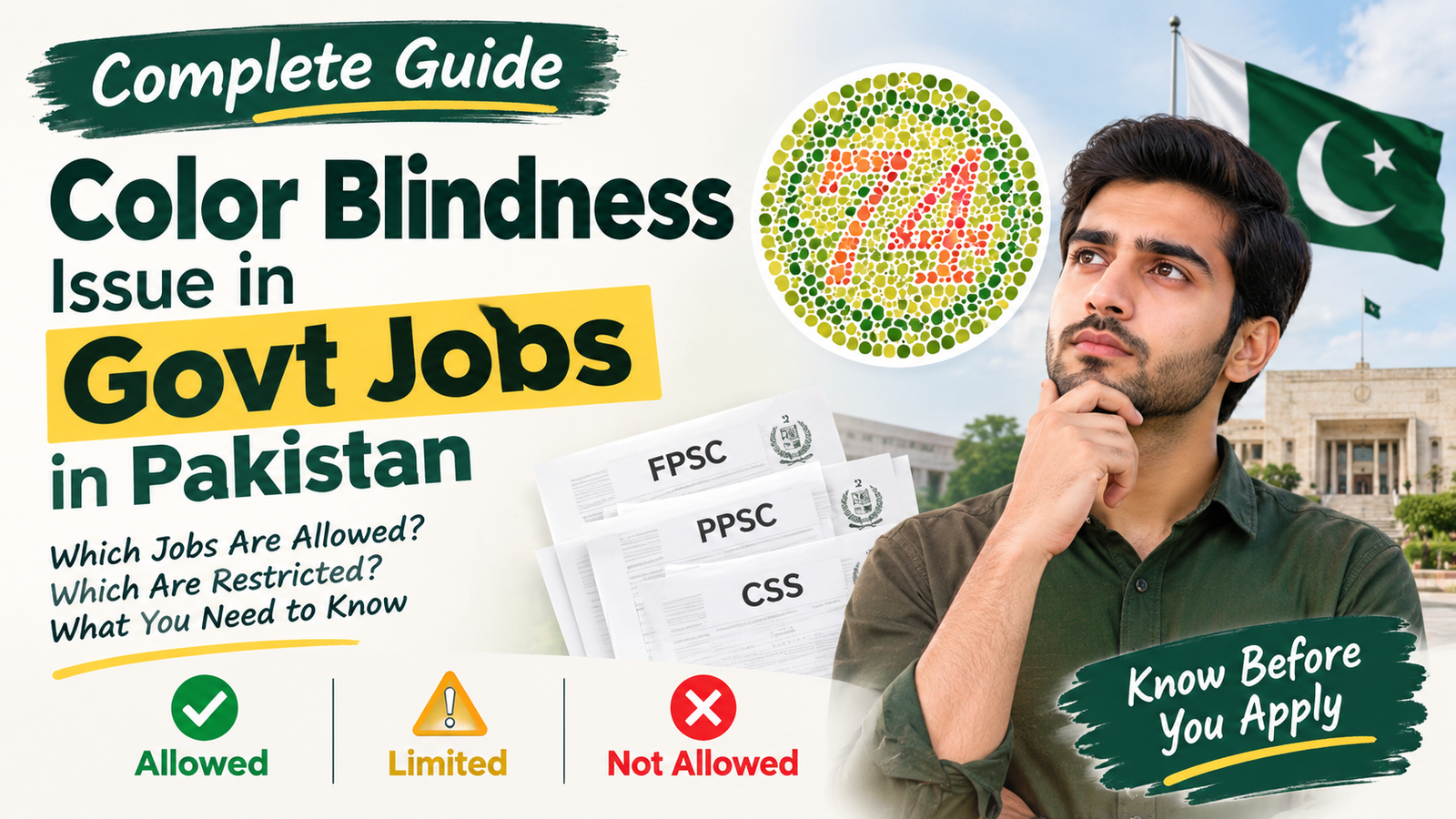
Color blindness is one of the most common eye conditions that can quietly disqualify an otherwise well-prepared candidate from a government job in Pakistan. Every year, thousands of aspirants spend months, sometimes years, preparing for PPSC, FPSC, CSS or armed forces recruitment, only to be turned away at the final medical examination because of a condition they never knew they had. Most had no symptoms, no complaints, and no idea that their ability to tell certain shades of red and green apart would decide their fate.
At the other extreme, many people believe that once you are color blind, every government job is closed to you. That is not true either. Pakistan’s government job landscape is not a single door but a large building with many entrances, and color blindness locks only some of them.
- Army, Navy, PAF (uniformed posts): color blindness is treated as disqualifying.
- CSS: Police Service of Pakistan (PSP) and Railways (Commercial & Transportation) restrict color-blind candidates. Customs should be verified (see below). Most other groups are generally open.
- PPSC / FPSC general posts: it depends on the hiring department and the specific post.
- Color blindness cannot be cured, so knowing your status early is the only real protection.
- How common is color blindness in Pakistan?
- What is color blindness?
- Types of color blindness
- Levels of severity
- Color blindness vs night blindness
- Which government jobs allow color blindness?
- What the courts have said
- Medical exam process at Services Hospital, Lahore
- What to do before you apply
- Frequently asked questions
How Common Is Color Blindness in Pakistan?
Globally, red-green color blindness affects roughly 1 in 12 men (about 8%) and 1 in 200 women (about 0.5%). The gap exists because the most common forms are inherited through the X chromosome. Men have only one X chromosome, so a single altered copy is enough to cause the condition.
Studies from Pakistan report a range of figures, usually lower than the global average:
| Study / Location | Group Tested | Reported Prevalence |
|---|---|---|
| Karachi, pre-employment screening (tertiary hospital) | Adults | 0.93% overall (1.41% men, 0.37% women) |
| Karachi, student study | Students | 2.75% overall |
| Bahawalpur (PAFMJ) | 1,000 male candidates | 3.1% |
| Quetta | General population sample | 5.75% of males, 1% of females |
| Lahore, dental students | Students | 7.55% of males |
The numbers differ because of different populations and testing methods. The consistent message is that color blindness is common enough that every large recruitment cycle will include affected candidates. In the Bahawalpur study, 93.54% of the color-blind candidates did not know about their condition until they were screened.
Timing makes this worse. In most recruitment processes the medical examination comes after the written test and interview, and sometimes after the offer letter. By then you have invested months and money. This guide shows you where you stand before that point.
Not sure about your own color vision?
Take a quick screening test before reading further. It takes only a few minutes.
Color Blindness Self-Test ToolAn online test is only a preliminary indication, not a medical diagnosis.
What Is Color Blindness?
Color blindness is not a disease. It is a color vision deficiency (CVD), in most cases a genetic variation in how the eye perceives color.
The retina contains light-sensing cells called cones, in three types: red-sensing, green-sensing and blue-sensing. Your brain combines their signals into the experience of color. In a color-blind person, one or more cone types is missing, malformed or weaker than normal. The result is rarely a black-and-white world. Most people with CVD see full color but struggle to tell certain hues apart, such as red and green, which can blend into brown or gray.
That is why medical boards do not simply ask “Can you see color?” They ask “Can you reliably distinguish the colors used in safety-critical signals, wiring and warnings?”
Acquired color vision deficiency can also develop later in life because of eye diseases (glaucoma, cataracts, diabetic retinopathy), nervous system conditions (such as multiple sclerosis), certain medications or eye injuries. It is rare, but it is one more reason the medical stage is a genuine screening point and not a formality.
Types of Color Blindness
Color blindness is a category of conditions. The type you have determines which colors you confuse and how a medical board is likely to treat you.
1. Red-Green Color Blindness
This is by far the most common form, accounting for the large majority of inherited cases. People with it tend to confuse reds, greens, browns and oranges, especially in poor light. It has four subtypes:
- Deuteranomaly (green-weak): the most common subtype. Green cones are present but shifted, so some greens look redder or muted. Usually mild.
- Protanomaly (red-weak): red cones are weak. Reds look darker and may appear greenish.
- Deuteranopia (green-blind): green cones are missing. Red and green cannot be reliably separated.
- Protanopia (red-blind): red cones are missing. Reds may look black or very dark.
2. Blue-Yellow Color Blindness
Much rarer, and it affects men and women equally because the gene is not on the X chromosome. People may confuse blue with green, and yellow with pink or red.
- Tritanomaly: reduced blue sensitivity.
- Tritanopia: blue cones are absent. Blues look greenish and yellows look pink or light gray.
3. Complete Color Blindness (Achromatopsia)
The rarest and most severe form, affecting roughly 1 in 30,000 people. Vision is limited to shades of gray, and it is often accompanied by strong light sensitivity, involuntary eye movements and reduced sharpness. Because it affects overall visual function and not only color, it is a far bigger barrier to government service than red-green deficiency.
Levels of Severity: Why “Color Blind” Is Too Broad a Label
Two candidates with the same label can face very different outcomes. What usually matters is how color blind you are.
| Level | What It Means | Typical Medical Board Attitude |
|---|---|---|
| Normal trichromacy | All three cone types work normally. | Passes all screenings. |
| Anomalous trichromacy (mild to moderate) | All cones present, one shifted or weak (e.g. deuteranomaly). | Can still fail Ishihara plates. Some non-safety-critical posts may tolerate it, but uniformed services generally do not. |
| Dichromacy (severe) | One cone type is missing (e.g. protanopia). | Usually rejected for any post requiring color recognition. |
| Monochromacy (complete) | No functioning color vision. | Not compatible with posts requiring color vision. |
Remember that standards are set by each recruiting body or department, so the same finding can be accepted for one post and rejected for another.
Color Blindness vs Night Blindness
These are two different conditions that people often mix up, and confusing them can make you misjudge your eligibility in either direction.
| Feature | Color Blindness | Night Blindness |
|---|---|---|
| Medical name | Color vision deficiency | Nyctalopia |
| Cells affected | Cones (color) | Rods (low light) |
| Main symptom | Trouble telling hues apart | Poor vision in dim light or at night |
| Usual cause | Mostly inherited | Often acquired: vitamin A deficiency, cataracts, retinal disorders |
| Everyday sharpness | Generally unaffected in normal light | Dark adaptation and low-light awareness affected |
Night blindness is generally treated as the more serious problem in recruitment because night duty, emergency response and field operations cannot be done safely without it. FPSC medical standards for CSS are reported to list night blindness as a cause of rejection for several groups, including Pakistan Administrative Service, Police Service of Pakistan, Customs and Railways. Check the current official notification for your year.
Which Government Jobs Allow Color Blindness?
The nature of the job decides everything. Here is the reality for each track.
| Track | If You Are Color Blind |
|---|---|
| Army / Navy / PAF (uniformed) | ❌ Not accepted. Usually found at the first medical. |
| CSS: Police Service of Pakistan, Railways (Commercial & Transportation) | ❌ Restricted under FPSC rules. |
| CSS: Customs | ⚠️ Verify against the current FPSC notification before applying. |
| CSS: Administrative, Foreign, Revenue, Audit, Commerce, Information, Postal, OMG, MLCG | ✅ Generally open, if visual acuity standards are met. |
| PPSC / FPSC general recruitment | ⚠️ Depends on the hiring department and the specific post. |
Armed Forces: Rejected on the Spot
Published medical standards for the Pakistan Army, PAF and Navy state that candidates should not be color blind. For pilot branches the eye examination is especially demanding. In practice the candidate is typically rejected at the initial medical stage, with no conditional acceptance. The Bahawalpur study mentioned earlier found that nearly all affected candidates first learned of their condition through screening.
The reality: if you are color blind and your goal is a uniformed military post, redirect your efforts early. Civilian posts connected with the military may have different standards, but these are not publicly standardized, so confirm with the specific advertisement.
CSS Civil Service: Only a Few Groups Are Restricted
For CSS (the FPSC Competitive Examination), color-blind candidates are explicitly excluded from the Police Service of Pakistan (PSP) and the Railways (Commercial & Transportation) Group. The status of Customs is reported differently in different sources, so check the medical standards in the notification for your exam year before treating it as open or closed.
The groups generally open to color-blind candidates, provided visual acuity standards are met, include:
- Pakistan Administrative Service (PAS, formerly DMG)
- Foreign Service of Pakistan (FSP)
- Inland Revenue Service (IRS)
- Commerce & Trade Group
- Pakistan Audit and Accounts Service
- Information Group
- Postal Group
- Office Management Group (OMG)
- Military Lands & Cantonments Group (MLCG)
PPSC / FPSC General Recruitment: The Department Decides
For general recruitment posts, the commission recommends candidates based on requirements received from the relevant department, and the medical standard is set by that department. A desk job in one department may have no color vision requirement, while a technical or field post in the same province may enforce a strict one.
The reality: there is no single answer. Read the specific advertisement and the department’s medical standards. Do not assume that because one post accepted a color-blind candidate, another will.
What the Courts Have Said: Reform Ordered, No Blanket Exemption
Candidates rejected from Punjab Police on vision grounds have gone to court, and the results show a system in transition, not a clear win for candidates.
- Lahore High Court (color blindness case): candidates for constable posts rejected at the final medical stage argued that the advertisement only asked for “medically healthy” candidates and did not mention color vision. The court examined the 1965 vision standard, the Police Rules and the medical certificate form, and the dispute centered on how the requirement was notified and applied. This was a procedural question, not a declaration that color blindness is acceptable for police service.
- Federal Constitutional Court (2026, general vision case): in a separate case involving a constable candidate rejected for eyesight, the court reportedly dismissed the appeal, holding that medical fitness is mandatory for police recruitment given the nature of the duty. It also reportedly directed a review of the roughly 90-year-old police medical rules in light of modern medical science.
The practical takeaway: courts have questioned how old rules are applied and called for reform, but no court has ruled that color blindness is automatically acceptable for field police posts. The legal landscape is evolving, but current reality remains restrictive. This section is general information, not legal advice. If you are challenging a rejection, consult a qualified lawyer.
The Medical Exam Process at Services Hospital, Lahore
After a PPSC recommendation, the hiring department usually issues an offer letter directing you to a medical examination. For candidates in Lahore, Services Hospital is one of the facilities used for this purpose.
Step 1: Reception and Diary Number
Start at the hospital reception, where you are directed to a doctor who marks your letter. You then obtain a diary number from the designated office. This is your tracking reference.
Step 2: Slip and Fee
At the Medical Examination Department your slip is generated and you pay a fee, which was under PKR 1,000 at the time of writing. In the PPSC general recruitment process described here, no additional fee was charged for the later tests. Other streams, such as CSS medicals, have different fee structures and venues.
Step 3: Initial Tests and Samples
Wait for your queue number, then you are called for:
- Blood and urine samples
- Height and weight measurement
- Distant vision eye test
- Color blindness test
Staff record the color vision finding but leave the final decision to the medical board. You are also given a slip for a chest X-ray, which was free of charge.
Step 4: Medical Board Appearance
On the assigned day, another distant vision test is done, a doctor may ask about the post you applied for and your medical history, you submit your form to the other doctors, and you are told when to collect your certificate. The whole process can typically be finished within about one working week.
Key point: the testing staff do not decide your fitness. They record findings and the medical board decides, applying the standard for your specific post.
What to Do Before You Apply: A 5-Step Action Plan
- Test your color vision early. Use a screening tool, then get a proper Ishihara test from an eye doctor or optometrist.
- Learn your type and level. Ask the examiner whether it is mild (anomalous) or severe (dichromacy).
- Read the advertisement and medical standards of the specific post, not general advice.
- Choose your track accordingly: uniformed services if your vision is normal, administrative, revenue, audit or desk-based posts if not.
- Check night vision and visual acuity separately. They are assessed under different standards.
Step 1 takes just a few minutes
Find out where you stand before investing months in preparation.
Color Blindness Self-Test ToolFrequently Asked Questions
Can a color-blind person get a government job in Pakistan?
Yes, for many posts. Uniformed services and a few CSS groups restrict it, but many administrative, revenue, audit and desk-based posts do not, depending on the department.
Can color blindness be cured or corrected before the medical?
Inherited color blindness is permanent. Special glasses may help some people tell shades apart but do not restore normal vision.
Is color blindness checked in the Pakistan Army, Navy and PAF?
Yes. It is screened at the initial medical and is generally disqualifying for uniformed posts.
Which CSS groups restrict color-blind candidates?
Police Service of Pakistan and Railways (Commercial & Transportation) are restricted. Verify Customs against the current FPSC notification.
Is mild color blindness treated differently from severe?
Sometimes. Standards vary by post, and some non-safety-critical posts may accept mild anomalies. Safety-critical and uniformed posts generally require normal color vision.
Who decides my fitness at the medical?
The medical board, not the technician who runs the test. The board applies the standard for the post you applied for.
Final Thoughts
The most dangerous position is the one most candidates are in: assuming they are either completely barred or completely safe without checking the specific post. The truth is almost always in between. Color blindness is not a reflection of intelligence or capability, but it is a medical fact that certain departments treat as a hard criterion. Know your status, pick your target carefully, and confirm the requirement before you apply.